Wednesday, 4 November 2015

"Don't Die in Autumn"


Thursday 8th October "Don't Die in Autumn"


Eric Dempsey's talk and book signing on the 8th was hugely successful, with a great turnout and a really enjoyable evening.  Eric as always was a very entertaining speaker, and he left with his load of books considerably lighter than when he arrived.

An interesting title selection by Eric, with its own amusing backstory....which will leave people to find in the book itself.


Thursday, 24 September 2015

In Search of Lizards and Other Strange Creatures

We set off at 10:30am in the morning into the hills of Tonevane just outside Blennerville, Co. Kerry. The pathway we take to the right brings you along part of the Dingle Way (also known as the Kerry Camino) but we veer left up into the hills and back across a small valley with a mountain stream at the bottom of it.
At first we encounter Bumble Bees and lots of Hover Flies that look a little like bees as they fly by. It quickly becomes apparent that this area is also home to the dreaded biting insect the Midge and with little or no breeze we are very quickly surrounded. We have to create our own breeze so we move on briskly to avoid being bitten.
Now today we are searching for Lizards (who eat insects) and other strange creatures and there is a big clue to the other creature we are looking for and that is lots of horse dung. Dung Beetles can be found around this area too as lots of horses graze these hills from the local equestrian centre. So not only are found in Africa, these creatures roll up a ball of dung lay an egg in it and bury it. Unfortunately we don't see any on our trip today and I think we may be a little to late in the season as they have been and gone until next spring I guess.
So as we continue along the pathway back down towards the valley mountain stream (followed by the midges) we come across the carnivorous Butterwort plant that sticky leaves trap and digest insects on (Midges beware!) even an Ant was seen stuck on one of the many plants we saw too. A small Froglet is spotted in this quite damp boggy heathland path as we discover another insectivorous plant, the round-leafed sundew. When a small insect lands on this plant its sticky hairy leaf gradually rolls up the trapped insect and the enzymes breakdown the insect absorbing the nutrients through the leaf. Sphagnum moss bogs of wet acid type habitats on a moorland are its perfect home.  Before the walk I left out some bait of meal worms on trays trying to tempt some lizards out into the open (normally a very shy creature). As we returned back down the pathway towards the car park we arrived to find one tray with a possible sign of Lizard passing straight through it as in a clear line of a dragging tale. So this gave us some hope but still no sign of one yet. We descended off the hill, very near to our finishing point and I checked the last tray of meal worms with no sign of any disturbance, when a shout went up for a Lizard! Just beneath Ger's feet he saw one very briefly as it shot into the grass for cover and disappeared.


Monday, 21 September 2015

Ed's Pelagic

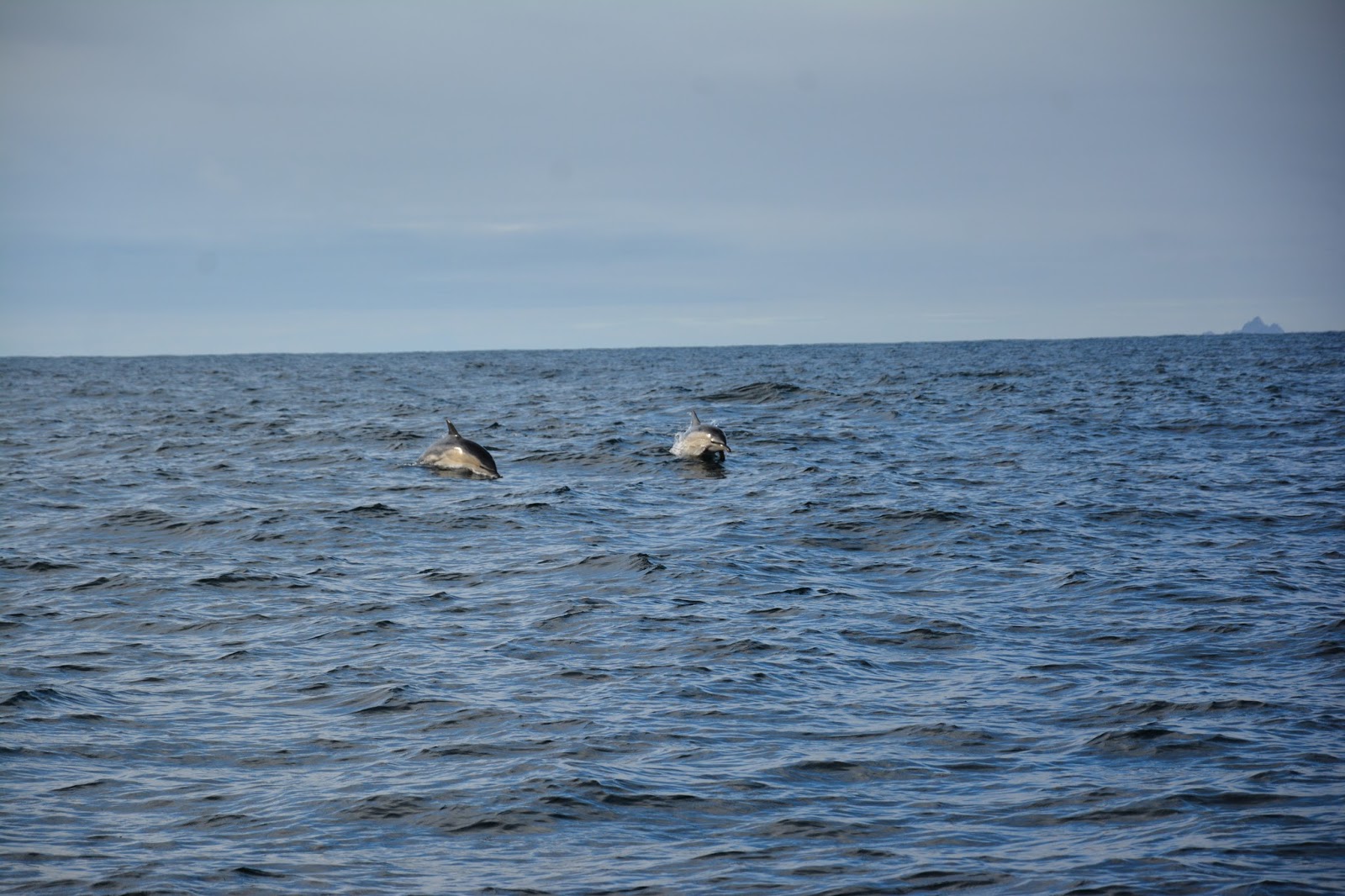
Ed's Pelagic duly set sail from Dingle on the 11th August. The purpose of pelagic trips like these is to find seabirds that rarely, if ever come in to land in Ireland, such as skuas, shearwaters, fulmar and petrels, but also provides the opportunity to explore and enjoy what the full variety of wildlife in the Kerry Seas. The Kerry Birding Blog contains a full account of the avian encounters, some of which in the pictures below as well as few others sights from the day.


Pod of common dolphins

Another pod paying us a visit 


Minke Whale
Gannet
Juvenile Gannet (4th Year)

Although difficult to catch in this shot can see several Gannets in various stages of diving, as well as a water splash and others taking off from the surface


Some Id fun :-) selection for Identification 

Fulmar


Sooty Shearwater


Arctic Skua

Kittiwake and Pomarine Skua


Herring Gull


Great Skua


Puffin


Monday, 13 July 2015

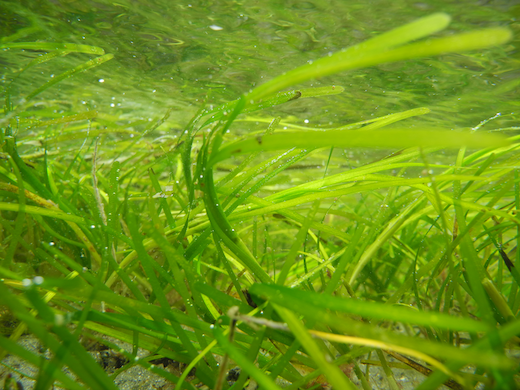
Introduction to Seagrass


Seagrasses are species of aquatic flowering plants which are grass-like in appearance. Globally there are four families of seagrass. Zostera from the family Zosteraceae is the only genus of seagrass present in Ireland. Despite the grass-like appearance they are more closely related to the pondweeds than the grasses. Overall two species (sometimes classified as three) are found along the Irish coast including dwarf eelgrass (Zostera noltii), the intertidal form of eelgrass (Z. marina Var. angustifolia) and eelgrass (Z. marina). Eelgrass species can be found in estuaries, tidal pools and mud flats, where they can form extensive beds. In Ireland dwarf eelgrass is present mainly in Kerry, Northern Ireland and the south east of Ireland; eelgrass has a more comprehensive distribution occurring along the north, south and west coast (National Biodiversity Data Centre, 2014).

The Tralee bay area covers an extensive area, of which much of the land is protected under European law. The bay is home to a number of special species ranging from seasonal visitors to permanent residents. This includes dwarf eelgrass which is of particular importance. Many other species in the bay depend either directly or indirectly on this species. Root and rhizome tissues are thought to anchor and stabilize sediment; this enables beds to exist for many years provided no large disturbances compromise the area. The relatively consistent environment created by dwarf eelgrass can have high species diversity; mainly rag worms, lug worms, cockles and small crabs.
In recent years public interest has been growing in areas of conservation. In the case of seagrasses most public knowledge is limited and so is active conservation in many areas. The ecosystem services of seagrass beds are valued at 19,004 $/Ha/year, three times greater than that of coral reefs (Costanza et al., 1997), making them worthy of some conservation attention. Eelgrass species have undergone rapid declines in recent years, from anthropogenic causes as well as a ‘wasting disease’ that destroyed Z. marina beds globally. Despite the decline Z. noltii and Z. marina are listed as ‘Least Concern’ in the IUCN databases. Local and regional declines in eelgrass populations are contributing significantly to overall species declines (Short et al., 2011). The need for conservation and restoration seems to be at a critical point given the improvements in water quality over recent years.


 Cliona Byrne, IWT Kerry Branch